Sunday, July 8, 2012


Your one and only digital mecca to kneel and worship at the shrine of America's greatest thespian, Sir Nicolas Cage. "My Buddy is a Cage" is a weekly feature where we revisit his great and... even greater filmography, one scenery-chewing rant at a time.
The Bad Lieutenant:
Port of Call - New Orleans
(2009)
* * *
I've written before that this weekly Cage-a-thon may produce some kind of numbing effect on my senses. Well, I think my nerves are working plenty fine.


Lt. Terence McDonagh (Cage) isn't the best at what he does. What he is best at is subverting the law at every expense. When he's not lifting drugs from the station's evidence locker, Terence gambles on college football or acts as a stand-in pimp for his prostitute ladyfriend, Frankie (Eva Mendes). Naturally, these less-than-savory qualities don't bode well for New Orleans' top detective, and McDonagh's vices come to catch up to him in the midst of solving a drug-related homicide.


If Borat drew the ire of Kazakhstan, I'd be shocked if The Bad Lieutenant didn't piss off a significant section of New Orleans. The city, as depicted here, is an awful place to live. All Werner Herzog shows us are grungy BBQ shacks, low-lit back alleys, and a number of crime scenes. Oh, and iguanas. Lots of them. As the synopsis alludes to, this film has a lot of drug use. And then some more, most of it involving McDonagh in some capacity. What the film attempts to show -- and I can't emphasize enough how uncertain I am about this -- is a glimpse inside McDonagh's drug-addled mind, so the resulting shifts between drama and borderline-comedy are as frequent as they are jarring. Hence the necessity of someone's soul doing a post-mortem breakdance:  


In Face/Off there's an obvious competition between Travolta and Cage as they out-impersonate each other. Here, most of Bad Lieutenant's cast act like they're trying to one-up Mr. Cage at chewing the set. Everyone is intoxicated or drugged up or so insane to such an extreme that the stakes become nonexistent. Of course, Cage remains king at spewing chunks of bat-shit psychosis at the camera. It isn't clear where the boundary between actor and script was set during production. Of course that doesn't stop Cage's McDonagh from shoving his hand cannon into a pair of octogenarians' faces or switching his own delivery into a nasally self-parody mid-way through. No, because in this realm, Cage wins. He always wins:


It's remarkable that a film with a detective at its core does such a shoddy job of outlining danger. McDonagh makes so many ridiculously poor judgments that it's sometimes impossible to separate his character traits from the plot. And maybe that's the point. McDonagh has become so numbed from this bleak career choice that he ironically turns toward the forces he's sworn to oppress. Except he's the same character for the entire film. I DON'T KNOW ANYMORE, because amidst a story with ludicrous pock marks, the festering wart is the character of McDonagh himself. 


There's a scene between McDonagh and Frankie where he presents her with a rusted spoon, presumably a gift as well as a reminder of her struggle with drug addiction. Again, I think. In this moment, the pair appreciate a quality in the spoon that a sober person wouldn't understand without some context or backstory. All of Bad Lieutenant is like this, as characters clearly see something in Lt. McDonagh that I do not. Frankie sees a twisted version of a dependable love interest. Xzibit's "Big Fate" and Det. Stevie Pruit (Val Kilmer) both envision him as a partner, whether that's in shady drug dealing or in solving a homicide case. As the ending makes clear, the New Orleans Police Department sees McDonagh as an officer worthy of promotion. But I don't see why. Someone pass me the blow.

Sunday, July 1, 2012


Your one and only digital mecca to kneel and worship at the shrine of America's greatest thespian, Sir Nicolas Cage. "My Buddy is a Cage" is a weekly feature where we revisit his great and... even greater filmography, one scenery-chewing rant at a time.
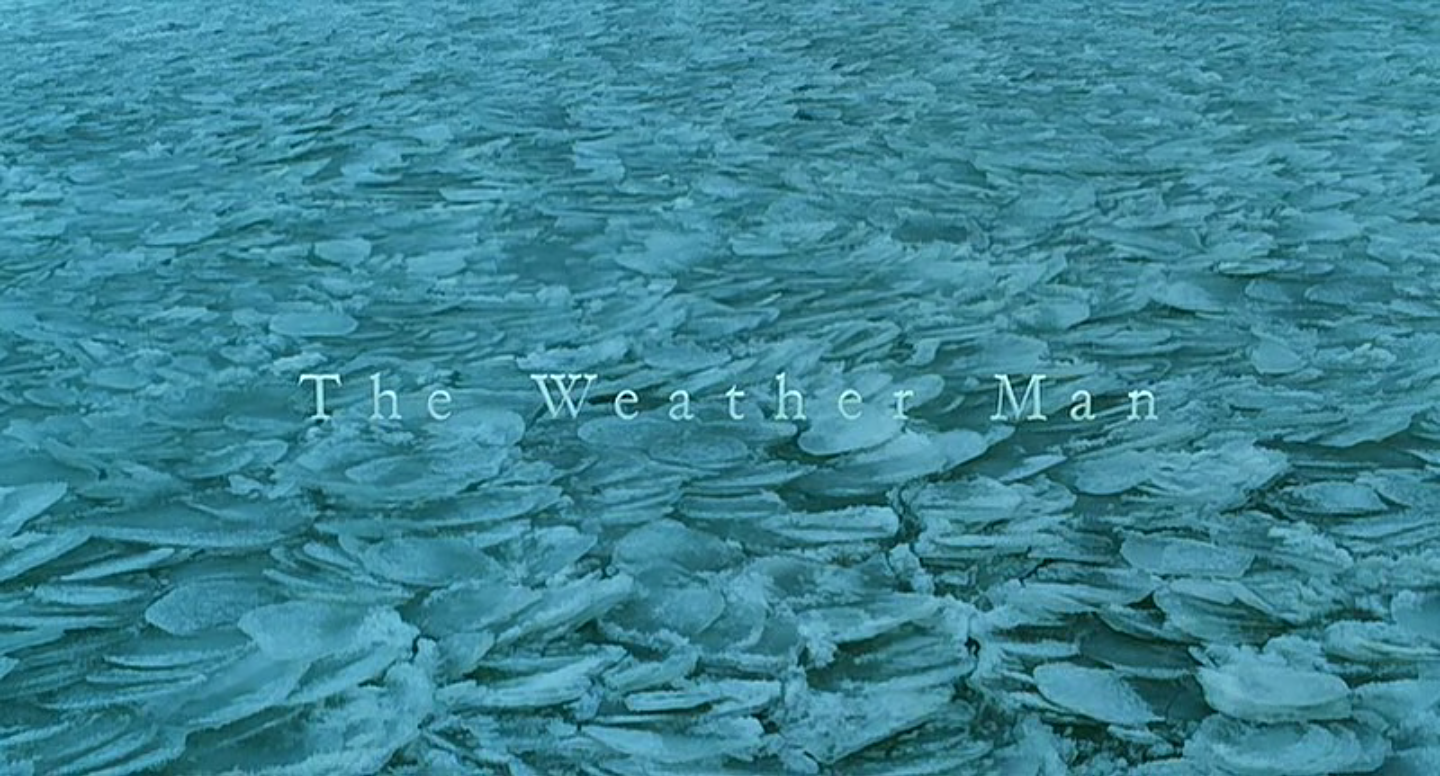
The Weather Man (2005)
* * *
Call it burnout but these weekly conjugal visits are beginning to wear me down. I'm not quitting or even taking a break. But I'll be finishing up a non-Cage-ian post later this week. 

I so excite!


Chicago weather man David Spritz (Nicolas Cage) is a sap. When he's not a walking target for half-consumed fast food, he's gaffing any headway with his estranged wife, Noreen (Hope Davis), and setting a bad example for his already dysfunctional kids. David struggles to make choices in his life when he simultaneously gets a promising job offer on Hello America and finds out his distant father (Michael Caine) has a terminal illness. And maybe he learns to return an ill-intentioned Hot Apple Pie or two along the way.


[Obvious comment about how obvious weather man metaphor for life is obvious]

What immediately struck me was The Weather Man's diminished scope and tepid tone, astonishing since this was helmed by Mr. Pirates o' Caribbean. Gore Verbinski shows he's capable of making more than three one solid action-adventure, The Ring notwithstanding. Oh, and everything looks great. In addition to having the best Pizza Chain name ever, Phedon Papamichael's photography casts Chicago in a somber blue malaise that may have doubled as a subtle sedative for Nic on set.  


I will admit that there is something off about listening to Michael Caine try out an American accent, but I have no idea if this was his doing or just my brain repeatedly saying FUCK NO FUCK NO THIS FEELS WRONG, ALFRED. Cage himself is pretty good in this. What with Adaptation. and now The Weather Man, I'm inclined to make a premature prediction and claim that Mr. Cage is much better when a script and/or director tells him to tone it the fuck down. No exceptions. Evar.


"People don't throw things at me anymore. Maybe because I carry a bow around. I don't know."

That there's the heart of The Weather Man. David Spritz does change, but we're not really told why, much less how. Is it because of that bow? Or is it because he takes his father's advice and learns to "chuck" some things in life? And what are those things? His responsibilities as a family man? After all, he does leave his ex-wife and children so he can chill with Bryant Gumbel in New York. I guess he still visits on weekends. That's okay right?

The script is the only flub here, but it's a big one. Steve Conrad provides ample laughs in debating the merits of the American fast food complex and adolescent camel toes, however I can't help take issue. David is kind of a fuck, even after his character changes... sort of. So if we're not meant to sympathize with a guy who has serious impulse problems, why do we spend 100 minutes following his life in the first place?

I can go with the ending here: David's not a family man, at least not in the way he envisioned. He's a weather man. Sure. But if the crux rests on sacking up and making those difficult adult choices, I'm not sure I get it. To be honest, David socking it to his son's molester counselor feels cathartic, but it's still a shortsighted action that either version of David Spritz, original or "changed" would probably take.

Finally, today in pieces of self reflection:

I think "old me" would have thoroughly enjoyed a montage of Nic Cage getting pelted with Chicken McNuggets and Big Gulps. Alas, I fear that my newly enlightened self now has sympathy for the man. But maybe Bad Lieutenant will right that wrong next week.

Sunday, June 24, 2012


Your one and only digital mecca to kneel and worship at the shrine of America's greatest thespian, Sir Nicolas Cage. "My Buddy is a Cage" is a weekly feature where we revisit his great and... even greater filmography, one scenery-chewing rant at a time.
Bangkok Dangerous (2008)
* * *

Following up yesterday's surprisingly enjoyable Face/Off comes the Pang Brothers' Bangkok Dangerous. Who wants to talk about Nic Cage's hairline?


Hired gun "Joe" (Nicolas Cage) travels to Thailand for a final series of hits before hanging it all up. While there, he takes a street punk, Kong (Shakrit Yamnarm), under his wing, as well as romances, Fon (Charlie Yeung), a deaf pharmacist. And that's about it.

So there is a plot to Bangkok Dangerous, but just barely. The first 60 minutes juggle Joe picking off various loathsome figures from Thailand's seedy underbelly, training montages with Kong ala Karate Kid (but probably the third one), and the worst of all, terribly uncomfortable moments where Cage plays the world's worst pick up artist. The real conflict though is when Joe, predictably, reconsiders his profession as an assassin, and yes, starts to change his ways. It isn't that easy, but it is that boring.


Nothing here engages or excites. It certainly doesn't innovate, and that's impressive considering how much Bangkok Dangerous really tries to do. It's a Frankenstein's monster of tonal shifts, mixing gritty, darkly-lit alleyway chases with date nights and combat training. This is apparently a Hollywood remake of the Pang Brothers' Thai release of the same name in 1999. Though I wonder if the original was more focused, I don't wonder about the motivations behind doing it again. *cash register sounds*


I've also got a strong suspicion Nic Cage is in this for similar reasons, as 2008 is roughly around the time when he starts piling on the paycheck roles. Cage's "Joe" is neither hammy nor interesting. He's filler, and nothing more. The real standout in this is his hairline, which is all sorts of whacked out. My research is threadbare here, but I'd venture this production is what spawned a real gem of a internet meme, too. Don't quote me on that:


If Face/Off proved anything, it was that "less" doesn't always mean "better." The over-the-top acting and ridiculous concept for a revenge actioner all congealed together. Bangkok Dangerousskeleton of a story and questionable characterization could've used some attention. It may have helped prevent the film from constantly tripping over itself in its drunken stupor to dazzle and satisfy on all levels. Because what does an audience gain if it's told when a double cross is coming, especially when that betrayal is at the hands of two-dimensional characters? 

Unless it's Nic Cage hair. Then less is always more.
Joe's four assassin "rules" that function as narrated bookends seem intended to explore ideas about guilt and consequence. Unfortunately, the ideas don't invert or reflect off of each other; Joe's narration is simply another obvious action beat in a sea of banality. In hindsight however, a few of his lines impart some wisdom to us: "Know when to get out. Just thinking about it means it's time."

90 minutes later, and I couldn't agree more.


Once again, I'm taking suggestions for next week. Be merciful.

Saturday, June 23, 2012


Your one and only digital mecca to kneel and worship at the shrine of America's greatest thespian, Sir Nicolas Cage. "My Buddy is a Cage" is a weekly feature where we revisit his great and... even greater filmography, one scenery-chewing rant at a time.
Face/Off (1997)
* * *
I know, I know. I came up short last week. Things got a bit hectic with the new job; these animals ain't gonna masturbate themselves. To make up for it, I'm doing back-to-back posts today and tomorrow. Excitement!

That brings me to Face/Off, the movie with an unnecessary slash in its title. Whether it's this or Se7en, the mid-90s were probably when all this shoving things into names fad started. No originality these days, I tell ya. Looking at you, Scre4m.


When serial terrorist Castor Troy (Nicolas Cage) accidentally kills the son of Special Agent Sean Archer (John Travolta), Archer vows for revenge. Years later, he gets that chance after tracking down Troy's latest bomb plot to level Los Angeles. Although Troy is gravely injured in the ensuing firefight, this film is more complex than other 90s action flicks like Bad Boys, where everything is simply tied up with explosions and Martin Lawrence quips. Troy's incarcerated brother and partner in crime, Pollux (Alessandro Nivola), refuses to reveal when his comatosed brother's bomb will go off, so Archer agrees to undergo experimental surgery take his face off (!) and replace it with Troy's to discover the brothers' plans before the explosion reduces LA to an even bigger geographic butthole. Whew. While Archer-now-as-Troy works his magic on Pollux, Troy wakes up and surgically assumes the mantle of Troy-now-as Archer, invading the professional and private life of his newly imprisoned nemesis. Naturally.


My fun-loathing self would have a lot to nitpick here, but even I can't be a Scrooge about this ridiculous premise when Face/Off so clearly doesn't take itself seriously. The concept alone -- the notion that one can assume another person's physical features, right down to bone structure -- would be asinine if the screenwriters weren't having so much fun with it. And let's not forget about the director, John Woo. I enjoy his legendary Hong Kong action piece, Hard-Boiled, and I definitely understand why he is involved with this project. The film is admirable in taking a crazy premise and showing how society's stark lines become obfuscated because of it. It's a trope that's been played out time and time again, yet so rarely to its fullest, bat-shit crazy extent.


Speaking of bat-shit crazy, let's not forget John Travolta aaand Nicolas Cage are in this thing, and fifteen years later, the parallels between their careers and acting choices aren't a whole lot different. Name Travolta's last good role? Either way, saying it's a complete riot watching both actors ape themselves would be a huge understatement. Take Archer-as-Troy's first foray into prison life as a testament to that:


I misspoke, that's actually Nic Cage playing John Travolta playing Nic Cage. Despite Cage accepting this role only because the majority of his screentime was as the protagonist, we get some solid scenery-chewing here. There are a slew of over-the-top cackles and a sequence where he orders an undercover fed to suck his tongue. Without a doubt though, Castor Troy's grand exit from LAX as a dancing, ass-grabbing preacher who spins and conducts his way through the opening credits takes the proverbial cake:


When you know enough to refer to Handel's "Messiah" by its actual title, you can grab as many rear ends as you want. I almost wonder if Cage would have been better off playing Sean Archer first. He's so magnetic as a villain. I think that's a good thing...


I will say Face/Off offers a fantastic solution to any parents with the unfortunate circumstance of grieving for a deceased child.

MILD/SPOILERS
: It's eventually revealed that Castor Troy shares a bastard son with ex-girlfriend Gina Gershon. Archer-as-Troy warms up to the child and in the film's final minutes, we get a surgically reconstructed Travolta/Face along with quite a demented ending. For Archer isn't coming home alone. He's brought newly orphaned Adam with him, as in the child of the man he ran down and murdered in a speed boat. The offbeat reactions Joan Allen and their daughter give are priceless, though I'm of the opinion that had they scripted more of this out, it would've been even better:

'Dead son? What dead son? Why my son is standing right here!' *pats head*

For tomorrow we'll be getting dangerous. Bangkok Dangerous.

Saturday, June 9, 2012


Your one and only digital mecca to kneel and worship at the shrine of America's greatest thespian, Sir Nicolas Cage. "My Buddy is a Cage" is a weekly feature where we revisit his great and... even greater filmography, one scenery-chewing rant at a time.

Adaptation. (2002)

* * *
Before we begin, credit goes to the girlfriend who stumbled across this gem earlier this week:


And keep the Nic Cage titles coming, people.  I need to at least pretend someone is reading this stuff.


Writer Charlie Kaufman (Nicolas Cage) -- an unfortunate mixture of self-loathing and hesitation -- struggles to adapt The Orchid Thief into his next screenplay and hopes to cure his writer's block with a meandering, voyeurisitc investigation of the book's author, Susan Orlean (Meryl Streep).  With the help of his twin brother Donald (Nicolas Cage!), Charlie discovers Orlean has become romantically involved her book's subject matter, the toothless, often delusional orchid hunter John LaRoche (Chris Cooper).  Frustration escalates, lives are changed, and everything somehow fits in to the greater arc of the planet's larger eco-history.  It's very Terrence Malick.


I've always found Charlie Kaufman's screenplays -- that's the real person, mind you -- to be overwhelmingly rich and dauntingly dense.  Part of that stems from his obsession with the "meta" realm of cinema; watch his directorial debut, Synecdoche, NY if you want to see what I mean.  But Kaufman's screenplays also boil over with dialogue, for there are moments in Adaptation that play out like an unfiltered Adderrall binge at a Friday night pub.  The incessant jawing is unrestrained but still directed, like a lawn mower you can steer but never hope to shut off.  And it all feels appropriate, because Charlie -- at least the filmic iteration of Charlie -- has a cluttered mind.

Cage's double portrayal of Charlie and Donald plays out like a facsimile of Tweedles Dee and Dum, albeit one that's often more pathetic than comical.  Take the following scene where Charlie experiences a flourish of inspiration only to have his spirits dashed when a giddy Donald arrives home from a screenwriting seminar:


"My genre's thriller, what's yours?"  It's easy to take jabs at something like Season of the Witch, but Adaptation is a different kind of beast.  In part, it's a story about injecting falsity into truth, since many of these characters are versions of real people.  If, to quote Streep's Susan Orlean, "change is a choice," Kaufman seems to be acknowledging that fictionalizing very non-fictional subject matter is a part of the screenwriting process he chose to make.  After all, what kind of a writer inserts himself into his own screenplay?  Probably the same kind who puts his own transgressions on trial via Florida swamp chase.


In adding to our digital cult of personality, iMDb claims that Cage resisted everything he knew about acting in portraying Charlie and Donald Kaufman.  And he earned an Academy Award nomination for it.

Saturday, June 2, 2012


Your one and only digital mecca to kneel and worship at the shrine of America's greatest thespian, Sir Nicolas Cage. "My Buddy is a Cage" is a weekly feature where we revisit his great and... even greater filmography, one scenery-chewing rant at a time.


Season of the Witch (2011)

* * *

Last time, I treated myself to the Brothers Coen and their deranged comedy, Raising Arizona.  This week, I wasn't so lucky.


Two renegade crusaders, Behmen (Nicolas Cage) and Felson (Ron Perlman), are reluctantly thrust back into serving the church when an ailing Cardinal (Christopher Lee) appoints them to escort a suspected witch (Claire Foy) to her trial.  If found guilty, her death may bring the end of a mysterious sweeping plague as well as the swift and painless end to a terrible movie.

It stands as a true cinematic testament that the individuals behind Season of the Witch manage to fuck up a simple premise so completely.  Our introduction to Behmen and Felson spans the course of twelve years, as we not only see the duo strike down God's enemies in a blaze of shoddy CGI and repetitive staging, but we also apparently learn that both characters are apparently ageless.  For the duration of this time the makeup department doesn't so much as bother to add a few wrinkles to Cage's complexion or touch up Perlman's grizzled facial hair into older, grizzled facial hair.  All this on the heels of a movie about killing fucking witches, though.  So touché I suppose.

Taking bets on whether or not that's a wig

What I enjoy most about Season of the Witch is Cage's unabashed nonchalance for the material.  Every actor apes his or her best vague Anglican accent except our two knights.  Ignoring the fact that nearly every period piece bafflingly equates "old" with "British," you mean to tell me nobody else in this film suspects something might be up with the two dudes speaking with straight American accents?  Ron Perlman sounds he ventured to Syria BY WAY OF THE BROOKLYN BRIDGE.  Ay, Yankees ahh playin' like shit fuggedaboutit! Is there a more egregious version of "phoning it in?"  You can probably make a lame E.T. reference somewhere here.

Maybe the beaks were used as a bacterial deterrent so that --
You know what?  Not even worth it.
If you've ever had the displeasure of seeing Blast From The Past, wherein a baby boomer Brendan Fraser is thrust into the hilarious antics of the mid-90's, time travel back to the middle of the Black Plague and that's how serviceable Nic Cage is here.

His performance, if we can stretch that term to its absolute limit and apply it to Season of the Witch, exists only in the loosest sense.  The character of Behmen amounts to donning nondescript medieval costumes and then making absolutely no attempt to convince the audience that this film isn't actually just Da Demon n' Nic Cage.


Just look at that thing.  Somebody should've been fired for that helmet.  And it might have been Nic Cage.

Next week: Adaptation!

Saturday, May 26, 2012


Your one and only digital mecca to kneel and worship at the shrine of America's greatest thespian, Sir Nicolas Cage. "My Buddy is a Cage" is a weekly feature where we revisit his great and... even greater filmography, one scenery-chewing rant at a time.


Raising Arizona (1987)

* * *
That banner alone probably deserves some kind of introduction.  Honestly, I have no idea why Nicolas Cage has become such an easy punchline these days.

Well, that's not exactly true.  It's fair to say he's elevated the art of scenery chewing to a completely different plane of existence.

Lord knows I haven't been the kindest to Mr. Cage's more recent ouevre, so what better way to apologize than with a weekly feature on a blog three people read?  As a gesture of good faith, I'm kicking this thing off with a film I already know is high quality: Raising Arizona.  See? I'm only a dick on Mondays!


Repeat offender and expert in petty crimes, H.I. (call him "Hi") McDunnough falls head over heels for Edwina (call her “Ed"), the police officer who habitually takes his prints and mugshot on each station visit.  The two of them settle down and Hi pledges to walk the straight and narrow path.  However when they realize they can’t have children, they make the next logical step: steal someone else's.  What follows is a game of hot-potato amongst several interested parties who all try to lay claim to the newborn infant.

Yes, this is my flaccid olive branch to Mr. Cage.  He's pretty darn good here.  Maybe it's because Cage's wild, uncouth spasms don't seem strange when bursting out of the much younger Hi.  Maybe it's Hi's slipshod tussock of a hairdo.  It's probably his mustache.


I'm referring to that caterpillar just north of his upper lip.  We are firmly entrenched in the late 80's, ladies and gentlemen.  The uncertain Southern drawl and the incessant Aloha shirt all add to Cage's portrait of Hi McDunnough, a portrait that's not split in two so much as it just hasn't had its finishing touhes yet.  There's a subtle (Yes! Subtle!) resignation to Hi, but Cage also weaves in this complacent melancholy.  Raising Arizona's fantastic first ten minutes features some quality Cage narration where he details a compacted metamorphosis of a very, very old child into a young man:


"I tried to stand up and fly straight, but it wasn't easy with that sumbitch Reagan in the White House."  It's goofy and a little morose at the same time, like a lot of the stories the Coen Brothers are interested in telling.  You can pick out elements from those opening sequences too: that up-to-no-good banjo? That's O Brother Where Are Thou?  And narration and the jabs at Reagan?  Big Lebowski all the way.  Even bits of Fargo's black humor first take root here.  Tonally, Raising Arizona's probably closest to The Ladykillers, even if I'd just as soon forget about that one.


Maybe the connection the Coens draw between crime and love is a bit easy to make.  But it's relevant.  Though he might not look it, Hi is a teenager.  That twinkle in his eyes belies as much of the mischief he finds himself in as the the head over heels love he's stumbled into.   There's an earnestness at work in Raising Arizona, a kind that forces its characters to make the difficult choice, to not shy away from the cold reality when one finds themselves penning a farewell letter to their dearly betrothed in the wee mornin' hours.


Next time: We'll jump forward to 2011's Season of the Witch!  If I'm drunk enough!